
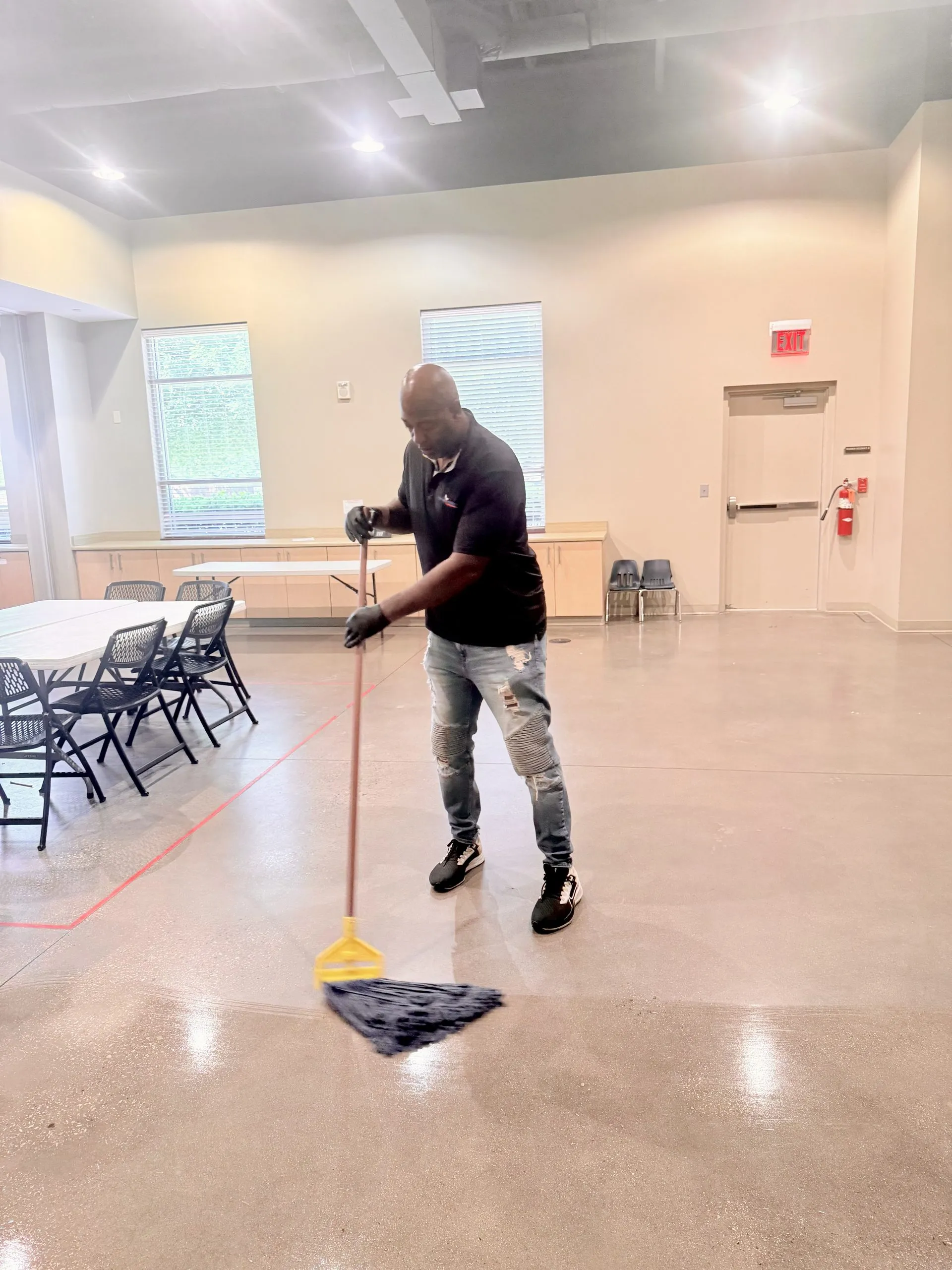
Mopping does not remove floor contamination. It redistributes it. A wet mop picks up loose debris from the surface and then spreads a thin film of dirty water across everything it touches. By the time the floor dries, that film has settled back into the finish, and the floor looks nearly as dull as it did before the crew started.
This is not a cleaning effort problem. It is a tool limitation. Mopping is designed for routine surface maintenance, not for removing the embedded residue, grit, and chemical buildup that accumulates on commercial floors over months of foot traffic. Regular mopping is necessary. It is also, on its own, not enough.
Commercial floors need a professional scrub at least once a year because regular mopping pushes dirt and residue rather than removing it, and dirty mop heads can spread contamination across the entire floor surface. In high-traffic environments such as building lobbies, warehouse aisles, and medical waiting rooms, that frequency should be higher. Skipping professional maintenance allows residue to build up until the floor finish breaks down, at which point the floor needs more extensive restoration work rather than routine maintenance.
What Mopping Actually Does to a Floor
A wet mop suspends loose surface dirt in the cleaning solution and drags it away. For lightly soiled floors, that process is adequate for day-to-day upkeep. The problem starts when the mop water turns dirty.
Once the cleaning solution picks up soil, every pass of the mop deposits that soil somewhere else on the floor. The visible debris may end up in the mop head or the bucket, but the dissolved dirt and cleaning residue gets spread in a thin, nearly invisible layer across the surface. When the floor dries, that layer hardens into the finish.
Over time, repeated mopping without professional intervention builds up this film layer by layer. The floor looks perpetually dingy. The finish appears scratched or dull even though nothing abrasive has touched it. Mopping harder or more frequently does not correct this because the tool cannot emulsify dried-on residue or extract what has worked its way into the surface.
This is the physical reality of mop-based cleaning on commercial floors. It is not a criticism of any cleaning crew. It is a description of what wet mops can and cannot do.
Three Reasons Commercial Floors Degrade Despite Regular Mopping
Regular mopping does not prevent floor degradation. Three specific mechanisms drive it, and each one operates independently of how often the crew cleans.
Residue from cleaning chemicals. Not every cleaning product is formulated for every floor finish type. When a product is not matched to the finish in use, it does not rinse away cleanly. It leaves a film on the surface. That film is slightly sticky, which means foot traffic deposits more dirt on top of it with each passing day. Over weeks and months, the floor looks like it needs stripping even if it was waxed recently. The fix is not to mop more often. It is to match the cleaning product to the floor finish and remove the existing buildup with mechanical scrubbing.
Dirty mop heads spreading contamination. A mop head that has not been cleaned or replaced between sessions carries the previous session’s soil into the current one. The bucket fills with what looks like clean water plus solution, but the mop head introduces contamination before the first pass.
Warning: A mop head used without cleaning or replacing between sessions carries the previous session’s soil back onto the floor. The floor is not being cleaned; the dirt is being redistributed.
Mopping cannot reach embedded grit. Fine particles accumulate in and around the floor finish in high-traffic lanes. A wet mop rolls this grit around but does not lift and remove it. Grit acts on the floor finish the way sandpaper acts on wood: slow, invisible abrasion that dulls the surface over time. The damage is gradual enough that it rarely gets attributed to grit. By the time the wear pattern is obvious in the finish, the floor is already significantly degraded.
How Often Commercial Floors Need a Professional Scrub
The practical threshold, drawn from 25 years of commercial floor maintenance in the Frisco area: at least once a year for most commercial spaces, more often in high-traffic environments.
High-traffic environments where annual scrubbing is not sufficient include:
- Building lobbies and main corridors
- Medical and dental waiting rooms
- Warehouse and manufacturing aisles (see warehouse floor maintenance for specifics on concrete and coated industrial surfaces)
- School hallways and common areas
- Any space where wet floors occur regularly from tracked-in moisture
The right frequency depends on three factors: how much foot traffic the space handles, what type of floor finish is in use, and whether the area gets wet on a regular basis. Tracked-in moisture accelerates grit buildup, which means a lobby with heavy pedestrian flow needs more frequent professional attention than a dry interior corridor with similar traffic counts.
The cost consequence of skipping professional floor scrubbing is direct. When the floor finish breaks down past a certain point, mopping cannot recover it. A professional scrub is routine maintenance. Letting the finish deteriorate past that point means a full strip-and-rewax cycle becomes necessary, which is a more involved and more expensive restoration process than a scheduled annual scrub.
Tip: If the floor still looks dull within 24 hours of mopping, residue has built up to the point where mopping cannot recover it. That is the signal for a professional scrub.
What Professional Floor Scrubbing Involves
A commercial floor machine applies cleaning solution under mechanical agitation from a rotating pad or brush, then extracts the dirty solution from the floor in the same pass. The extraction step is what separates machine scrubbing from mopping.
With a mop, dirty solution stays on the floor until it evaporates or gets pushed to the baseboards. With an auto-scrubber, dirty solution is vacuumed up immediately after agitation. The commercial floor is left clean at the surface level, not just redistributed-clean.
After scrubbing, the floor surface is prepared for whatever comes next. If the floor finish is still intact, the floor simply looks better: brighter, less dull, without the film that repeated mopping deposits. If the finish has been worn down over time, the scrubbed surface is clean enough to accept a fresh coat.
Note: Scrubbing maintains the floor finish. Stripping removes it. A well-maintained floor needs stripping less often.
When the floor finish has been ground down past what scrubbing can recover, a full floor scrubbing and refinishing service removes the old finish entirely and applies new coats. That is a restoration process, not routine maintenance. Facilities managers who schedule regular professional scrubbing typically go longer between full strip-and-rewax cycles because the finish gets maintained rather than ground down between visits.
Frequently Asked Questions
How often should a commercial floor be professionally scrubbed?
Most commercial spaces need a professional scrub at minimum once a year, with high-traffic areas requiring two to four visits annually. But frequency alone does not tell the full story. The right schedule depends on floor type, finish condition, and traffic patterns specific to your space. A walk-through inspection of the facility is the most reliable way to set that schedule, because what looks fine in a low-traffic hallway may already be overdue in a lobby or warehouse aisle.
Can the wrong cleaning chemical damage a commercial floor?
Yes. Cleaning products that are too alkaline, or that are not matched to the floor finish type in use, leave a film on the surface rather than cleaning it. Over repeated applications, this film builds up, and the floor can look dirty again immediately after mopping. Using a neutral-pH cleaner matched to the specific finish type prevents this accumulation and reduces how quickly residue builds to the point of needing mechanical removal.
Is professional floor scrubbing the same as strip and wax?
No. Scrubbing is routine maintenance; stripping is restoration. A floor that receives regular professional scrubbing typically needs stripping less often, because the finish is maintained between visits rather than ground down to the point where only a full removal and recoat can recover it. Scrubbing extends the life of the finish. Stripping replaces it when that life has run out.
Does floor type affect how often you need to scrub?
Yes. VCT tile, common in offices and medical facilities, accumulates finish buildup that requires mechanical agitation to remove. Polished concrete, common in warehouses and industrial spaces, collects grit in the surface pores that a mop cannot reach. Carpet requires extraction, not scrubbing. The floor type determines both the cleaning method and the appropriate maintenance frequency. A facility with mixed floor types may need different schedules for different areas.
When to Call a Commercial Cleaning Service
There are clear signals that mopping has reached its limit: floors that look dull within a day of cleaning, grit visible in high-traffic lanes, and scuff tracks in the finish that do not buff out. Any one of these indicates that residue or grit has built up past what a wet mop can address.
Frisco Brothers Janitorial Service has provided commercial floor maintenance in Frisco and surrounding cities since March 2001. The company operates with 26+ staff, holds a bond through Hartford Insurance, and carries a 5.0 / 56 Google reviews rating built across 25 years as a commercial janitorial service in the area.
For offices, medical facilities, and commercial buildings that need professional floor maintenance, office cleaning services from Frisco Brothers include scheduled floor scrubbing as part of a full commercial cleaning program. Facilities with more demanding floor requirements, including warehouses and industrial spaces, are served under a separate program built around the specific demands of those environments.
To assess whether your floors need a professional scrub or to schedule service, contact Frisco Brothers Janitorial Service at (214) 618-0816 or request a free walk-through through the contact form.